
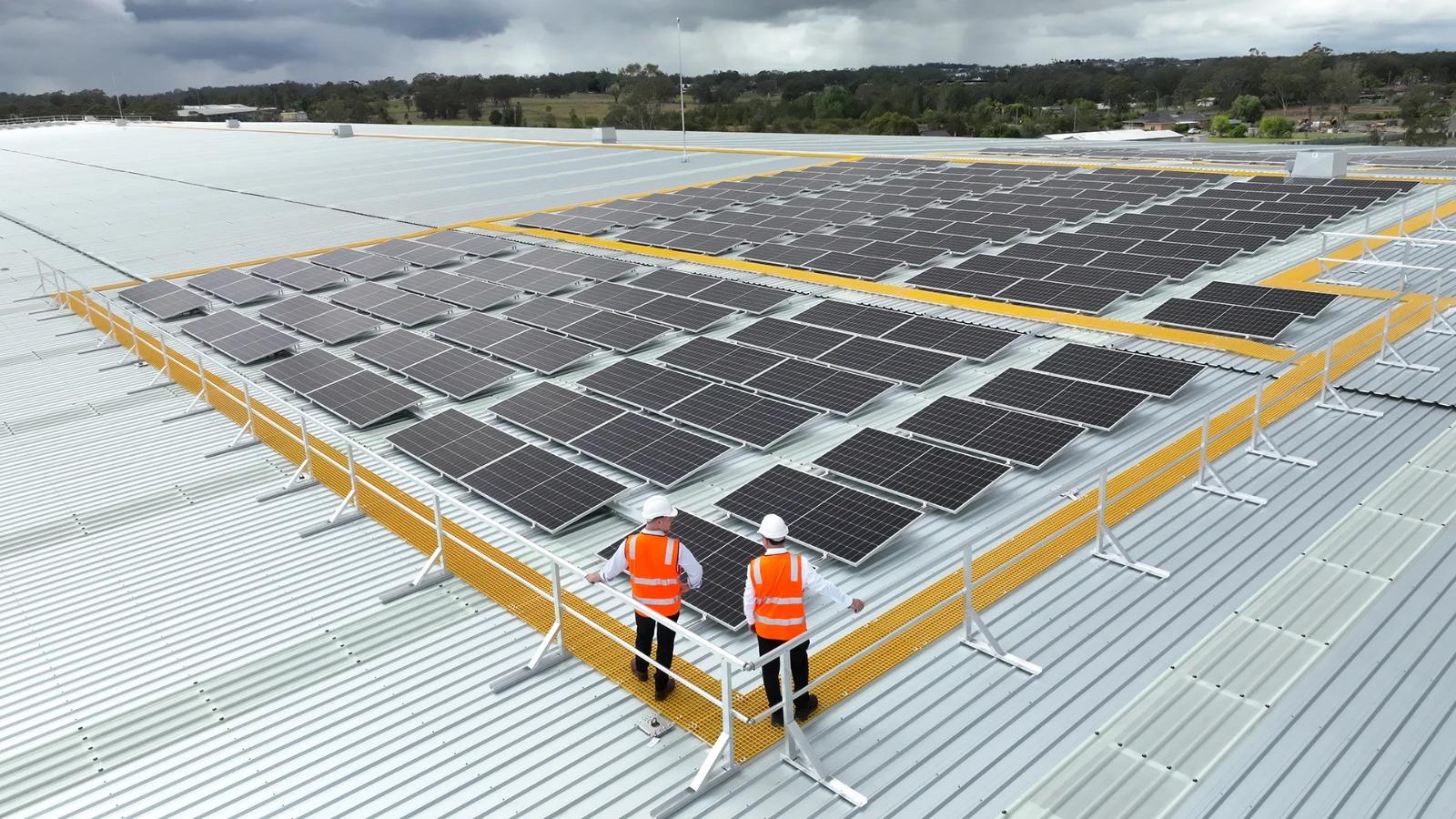
Source: heightsafety.net
For many factory owners and plant managers, rooftop solar looks like the ideal asset. Once the panels are up, the system runs quietly, cuts electricity bills, and needs little attention beyond occasional cleaning. It is easy to see why commercial and industrial (C&I) solar has earned a reputation as a low-risk, install-and-forget investment.
That reputation is only partly deserved. As adoption speeds up across Indonesia and Southeast Asia, engineers, researchers, and regulators are paying closer attention to a risk that many site owners haven't considered: fire. Industrial solar fire risk is not a fringe concern or a hypothetical. It is a documented and growing issue, and it deserves a place in every operations director's risk planning.
What the Research Shows
Technical and academic risk assessments of rooftop solar in Indonesia have identified fire as a real and rising concern. These studies look at installations against Indonesian standards and regulations, including PUIL 2020, SNI IEC 62548, SNI 03-7015, and Permen ESDM 2/2024. They also compare local practice with experience from mature solar markets such as Australia, the United Kingdom, and Japan. Several common themes appear.
The DC side behaves differently. Solar panels produce direct current (DC), and DC electrical faults are harder to interrupt than alternating current (AC) faults. Alternating current passes through zero many times per second, which helps an arc extinguish itself. Direct current does not. A DC arc can therefore sustain itself, generating intense, localised heat that can ignite surrounding materials. This is a big part of why the DC side of a solar system carries higher fire risk.
Connectors are a frequent weak point. Connectors such as MC4 components join modules and cables across the array. Substandard or mismatched connectors, and connectors that were improperly crimped or tightened to the wrong torque, can loosen or degrade over time. The resulting resistance creates heat, and heat at a poor connection is a common starting point for arcing.
Components degrade. Panels, cables, and junction boxes age under constant sun, heat, and humidity. Modules can develop hotspots, which are areas that run significantly hotter than the rest of the panel, due to cell damage, shading, or manufacturing flaws. Over years of operation, these small degradations can become ignition risks.
Workmanship matters more than most owners realise. Many of the risks above come down to installation quality. Research points to poor workmanship and gaps in standards compliance as significant contributors to fire risk. Cables may be routed badly, components may be mismatched, or connections may be made carelessly. Oversight is often missing. Technical assessments also highlight a lack of adequate technician certification and independent installation audits. Without these checks, installation defects can go unnoticed until something goes wrong.
None of this means rooftop solar is unsafe. It means that fire risk depends heavily on component quality, installation standards, and ongoing inspection. Those factors vary widely from one site to the next.
Why Battery Storage Raises the Stakes
Solar is increasingly being paired with battery energy storage systems (BESS). Indonesia's RUPTL assigns a share of new capacity to storage, and Vietnam now mandates BESS on new centralised solar. In practice, solar and storage are becoming a single investment decision.
Storage brings real benefits, but it also compounds the risk profile. BESS fire risk works differently from panel fire risk. A fault in the energy management system, which controls how batteries charge and discharge, can cause batteries to overheat. If overheating isn't contained, it can escalate into thermal runaway. In this self-reinforcing chain reaction, rising temperatures trigger further heat release, potentially leading to fire.
The consequences reach beyond the battery itself. Many C&I systems are integrated closely with the facility they power, so a single failure can halt production across the whole site, not just damage one piece of equipment.
The Real Cost Is Financial, Not Just Technical
It is natural to think of a solar fire in terms of damaged equipment. For a business, the damaged panels or batteries are often the smallest part of the loss.
Lost production during the outage can far exceed repair costs, especially for facilities running continuous operations. If a fire or falling component injures someone or damages neighbouring property, the site owner may face third-party claims. A BESS fire can also create chemical or environmental contamination, which carries its own liability and clean-up obligations.
Here is where many site owners hold a critical misunderstanding: manufacturer warranties do not cover these losses. A warranty protects against a defective product. It may replace a faulty panel or inverter. It says nothing about fire from an installation fault, weather damage, lost revenue while the system is down, or harm caused to third parties. The warranty covers the product, and insurance is what covers everything else.
An Overlooked Segment
C&I solar and storage are scaling rapidly across Indonesia and the region. Yet many site owners are underinsured or entirely uninsured for these exposures. This isn't negligence. The 2-15MW segment has simply been overlooked. Traditional brokers and reinsurers tend to focus on much larger utility-scale projects, and many have not built a technical product for sites of this size. The result is a gap between the risks C&I solar owners carry and the protection available to them.
Powersure was built to close that gap. We are a specialist insurance platform focused on C&I rooftop solar insurance in Indonesia and across Southeast Asia, including the battery storage paired with it. We cover the exposures warranties don't, from fire and weather damage to business interruption, third-party liability, and environmental risk, for sites in the 2-15MW range. If you operate or are planning a solar or BESS installation, we'd welcome a conversation about your site's actual risk exposure and how to protect it. Get in touch with our team to learn more.